Empire of Plans: A Social History of Inequality in Liverpool and Nairobi During the Long 20th Century
This project consists of two stand-alone monographs, both of which are in production with Palgrave Macmillan’s Cambridge Imperial and Post-Colonial Studies Series. The anticipated release date for both books is March 2027.
Publisher’s Blurbs
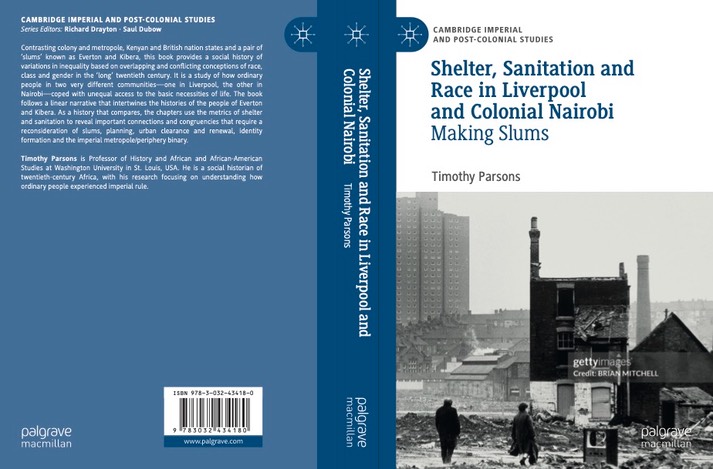
Making Slums: Shelter, Sanitation and Race in Liverpool and Colonial Nairobi
Contrasting colony and metropole, Kenyan and British nation states and a pair of ‘slums’ known as Everton and Kibera, this book provides a social history of variations in inequality based on overlapping and conflicting conceptions of race, class and gender in the ‘long’ twentieth century. It is a study of how ordinary people in two very different communities—one in Liverpool, the other in Nairobi—coped with unequal access to the basic necessities of life. The book follows a linear narrative that intertwines the histories of the people of Everton and Kibera. As a history that compares, the chapters use the metrics of shelter and sanitation to reveal important connections and congruencies that require a reconsideration of slums, planning, urban clearance and renewal, identity formation and the imperial metropole/periphery binary.
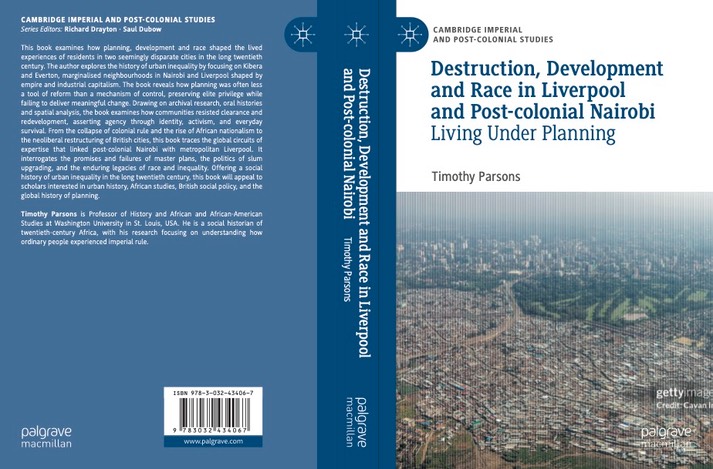
Living Under Planning: Destruction, Development and Race in Post-Colonial Nairobi and Liverpool
This book examines how planning, development and race shaped the lived experiences of residents in two seemingly disparate cities in the long twentieth century. The author explores the history of urban inequality by focusing on Kibera and Everton, marginalised neighbourhoods in Nairobi and Liverpool shaped by empire and industrial capitalism. The book reveals how planning was often less a tool of reform than a mechanism of control, preserving elite privilege while failing to deliver meaningful change. Drawing on archival research, oral histories and spatial analysis, the book examines how communities resisted clearance and redevelopment, asserting agency through identity, activism, and everyday survival. From the collapse of colonial rule and the rise of African nationalism to the neoliberal restructuring of British cities, this book traces the global circuits of expertise that linked post-colonial Nairobi with metropolitan Liverpool. It interrogates the promises and failures of master plans, the politics of slum upgrading, and the enduring legacies of race and inequality. Offering a social history of urban inequality in the long twentieth century, this book will appeal to scholars interested in urban history, African studies, British social policy, and the global history of planning.